Planning Your Facial Rejuvenation: How Dr. Sharma Builds a Personalized Approach

Planning Your Facial Rejuvenation: How Dr. Sharma Builds a Personalized Approach
Over the course of this series, we’ve covered a lot of ground — how the face ages at a structural level, what each zone involves (brow, eyes, midface and jawline, and neck), which procedures address which concerns, the role of fat grafting in restoring volume, and how to think about the surgical versus non-surgical decision. If you’ve read through to this point, you likely have a clearer picture of facial rejuvenation than the majority of patients who walk into a consultation room.
This final post is about what happens in that room — how the conversation unfolds, what Dr. Sharma is evaluating, how a plan gets built, and what you can do to make the most of that appointment.
What the Consultation Is For
A consultation at SKS Plastic Surgery isn’t a sales presentation. It’s an evaluation. Dr. Sharma takes time with each patient to understand not just what they’re bothered by, but what they’re hoping to feel like afterward. Those are related but distinct questions, and the answer to the second one is ultimately what guides the plan.
He’ll look at your face the way a surgeon looks at a face: assessing brow position relative to the orbital rim, evaluating upper and lower lid laxity and fat distribution, examining cheek volume and the degree of midface descent, assessing the jawline and the quality of jowling, and evaluating the neck — skin laxity, submental fat, platysmal tone, and the cervicomental angle. He’ll also assess your skin quality, your bone structure, and how your face moves, because all of these things inform what’s possible and what’s most likely to produce the result you’re after.
He’ll ask what you see when you look in the mirror. He’ll ask what specifically bothers you, because sometimes the thing a patient mentions first isn’t actually the thing that would make the biggest difference. And he’ll be direct about what he thinks — not just what he can do, but what he thinks will genuinely serve you best.
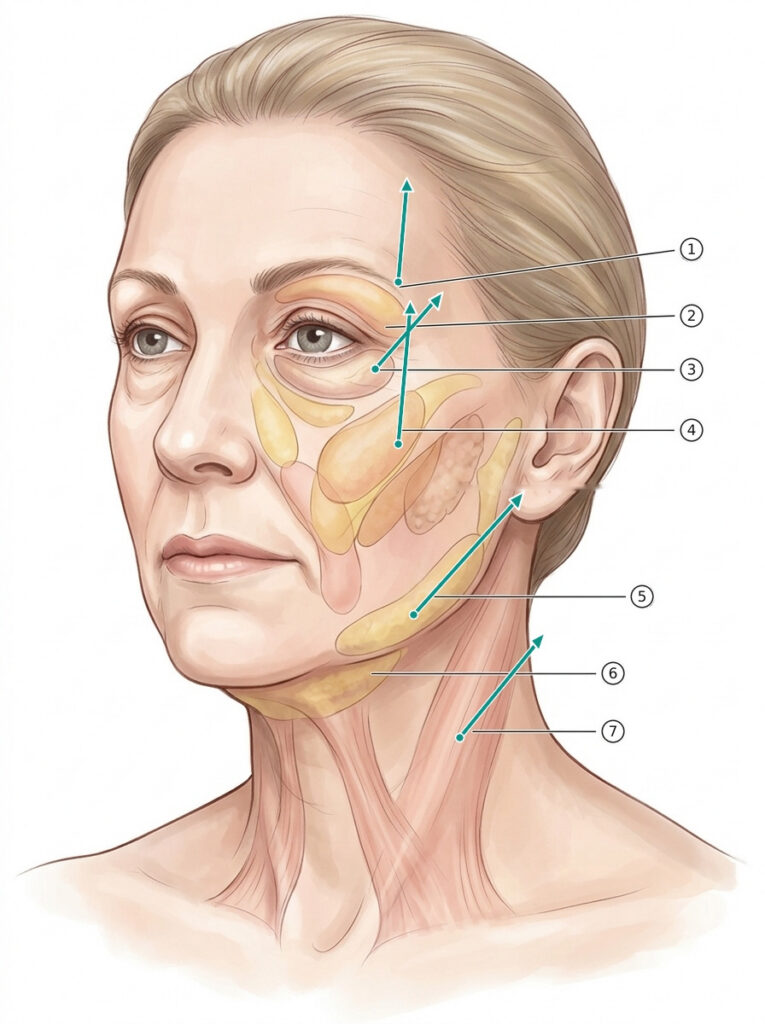
- Brow position and descent
- Upper eyelid laxity
- Lower eyelid and under-eye fat
- Cheek volume and midface descent
- Jawline definition and jowling
- Submental fat
- Neck: platysmal bands and skin laxity
How to read the illustration: the teal arrows are lift vectors. They show the general direction in which tissue that has descended with age is repositioned to restore a more youthful position — straight up at the brow and midface, up and outward at the lower eyelid, and up and back toward the ear along the jawline and neck. The yellow shapes are the facial fat compartments described in Part 1, which can lose volume or descend over time. The arrows are illustrative only: the direction and degree of lift differ from patient to patient, which is why Dr. Sharma evaluates each of these areas individually in consultation.
How a Plan Gets Built
The plan that emerges from consultation is almost never just a list of procedures. It’s a considered recommendation that takes into account your anatomy, your timeline, your recovery capacity, and your goals — and it’s always framed in terms of what will produce the most natural and lasting result for this particular patient.
Some patients come in expecting to hear that they need a facelift and are told they’re not quite there yet — that their concerns are better addressed non-surgically for now, and that surgery in a few years will give them a better result than surgery today would. Others come in hoping for a non-surgical solution and are told honestly that their degree of change has moved past what injectables can meaningfully address. Both conversations are valuable, and both reflect the same underlying principle: the recommendation should fit the patient, not the other way around.
For patients who are appropriate surgical candidates, Dr. Sharma will discuss the specific procedure or combination of procedures he recommends, the surgical approach, the type of anesthesia, the facility, the expected recovery, and what the results will realistically look like. He’ll also discuss timing — because for many patients, scheduling a procedure around work, family obligations, or an upcoming event is a practical consideration that shapes the plan.
Common Questions Worth Asking
If you’re preparing for a consultation — whether with Dr. Sharma or any other surgeon — there are questions that tend to be particularly useful to ask:
- What specifically about my anatomy leads you to this recommendation?
- Are there alternative approaches, and what are the tradeoffs?
- What does recovery look like in practical terms — how many days before I’m comfortable being seen, before I can drive, before I can exercise?
- Can you show me before and after photos of patients with similar concerns and anatomy?
- What happens to the result over time, and what maintenance will I need?
The quality of the answers matters as much as the answers themselves. A surgeon who takes the time to explain their reasoning — who doesn’t rush the appointment and doesn’t make you feel like you’re on a conveyor belt — is demonstrating something about how they approach their work that will show up in the operating room as well.
A Note on Timing
One of the most consistent observations in facial surgery is that patients often wish they had come in sooner. Not because they necessarily would have had surgery sooner — but because the information from a consultation changed how they thought about their options, and gave them a clearer sense of where they were headed and what would be possible when the time was right.
If you’ve been thinking about this for a while, a consultation is not a commitment. It’s a conversation. And it’s usually far more useful, and far less intimidating, than people expect it to be.
Thank You for Reading This Series
We hope this series has given you a more complete and nuanced picture of facial aging and rejuvenation than you had when you started. The face is complex, aging is a layered process, and the decisions around what to do — and when — are genuinely individual. There is no single right answer, but there is a right answer for each patient, and finding it starts with good information and an honest conversation.
We’d be glad to have that conversation with you. Dr. Sharma’s office is in Austin, Texas, and he sees patients from throughout the greater Austin area and beyond. Call (512) 324-2765 or use the contact form on this site to schedule a private consultation.