The Neck: Restoring What Aging Exposes

The Neck: Aging’s Biggest Giveaway (and the Cure)
If asked to identify the one area of the face and neck that patients point to most often in consultation — the thing they’re most bothered by, the thing that finally made them pick up the phone — Dr. Sharma would say the neck. Not the jowls, not the eyes, not the forehead. The neck.
There’s something about neck laxity that patients find particularly difficult to accept, and the reasons are worth understanding. The neck is visible at every conversational distance. It’s not something you can conceal with makeup. It photographs prominently. And unlike some signs of facial aging that develop gradually enough to accommodate to, changes in the neck often feel more sudden — or at least more jarring when finally noticed. Patients frequently describe looking in the mirror one day and feeling like their neck simply doesn’t match the rest of how they feel or how they present themselves.
That frustration is completely valid. And the good news is that the neck is one of the most responsive areas in all of facial rejuvenation. When it’s addressed properly, the transformation can be dramatic.
Why the Neck Ages the Way It Does
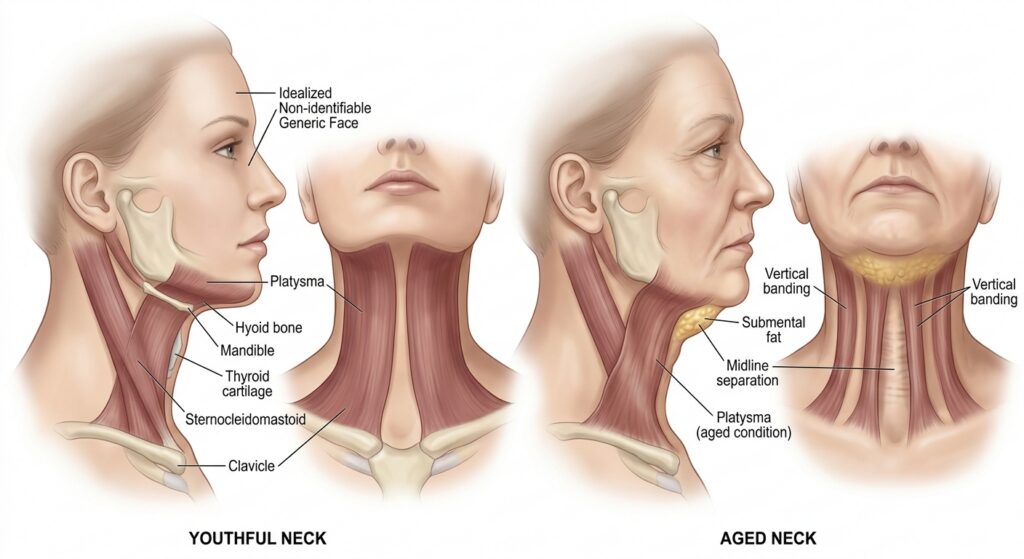
The primary structure responsible for the neck’s appearance is the platysma — a broad, flat muscle that runs from the collarbone up through the neck and into the lower face. In youth, the platysma forms a continuous sheet that maintains the clean, defined angle between the chin and neck known as the cervicomental angle. As we age, two things happen: the platysma begins to separate along the midline, creating the vertical bands that run down the front of the neck, and it loses overall tone, allowing the overlying skin to sag and the underlying fat to become more prominent.
Simultaneously, fat accumulates beneath the chin — in the submental space — and the skin itself loses the elasticity needed to retract on its own. The result is the combination of changes that patients describe as a “turkey wattle,” a “double chin,” or simply “loose skin on my neck” — all of which are manifestations of the same underlying process, often occurring together.
What makes the neck particularly challenging to treat non-surgically is that the platysma doesn’t respond to topical products, injectables, or energy-based devices in any meaningful way. These treatments can improve skin texture and provide modest tightening, but they can’t reapproximate separated muscle edges, remove fat from a defined anatomic space, or retract significantly loose skin. For patients with moderate to significant neck laxity, surgery is the only option that produces results commensurate with the degree of change they’re seeking.
What a Neck Lift Actually Involves
A neck lift — technically called a platysmaplasty when it involves the platysma muscle — addresses the neck comprehensively. Through a small incision under the chin and incisions behind the ears, Dr. Sharma is able to directly access the platysma, bring the separated edges back together along the midline (a step called a plication), and tighten the muscle to restore a more defined, youthful contour.
Any excess submental fat can be removed at the same time — through direct excision or liposuction — and the overlying skin is re-draped and tailored. The incision behind the ears, hidden in the natural crease, handles any excess skin that needs to be removed from the lateral neck.
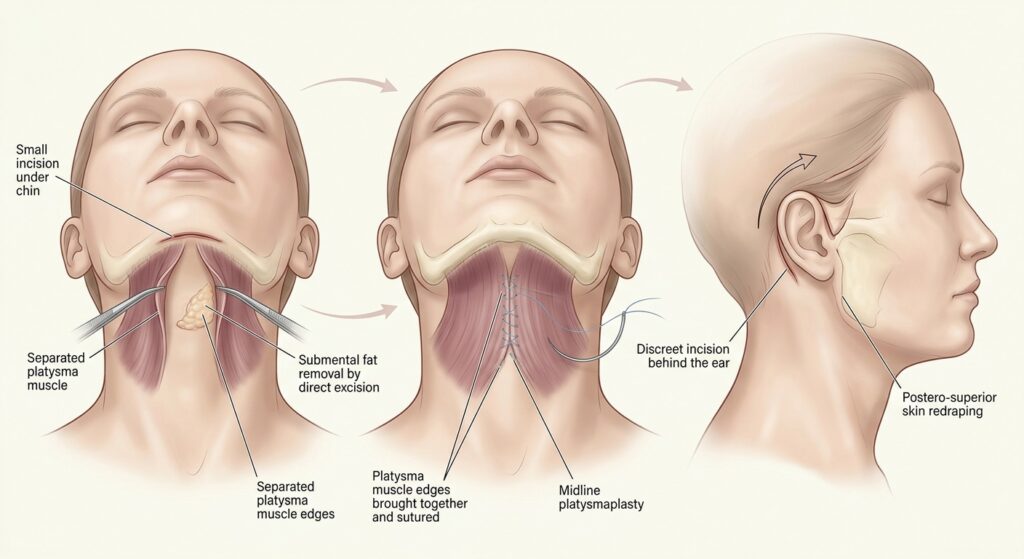
The result, when done well, is a neck that looks clean, defined, and structurally sound — not stretched or artificial. The cervicomental angle is restored. The platysmal bands are gone. And the profile, which patients often don’t think to focus on until they see the post-operative photos, is dramatically improved.
Why the Neck and Facelift Belong Together
The neck and the lower face are anatomically continuous — they share the same underlying muscle layer and the same envelope of skin. This is why a facelift without a neck lift can sometimes produce a result that feels incomplete: the midface and jaw are refreshed, but the neck — still showing its age — creates a visual disconnect that’s hard to ignore.
For most patients who have significant neck laxity alongside midface and jawline descent, Dr. Sharma recommends addressing both in a single procedure. The incision placement overlaps substantially, the recovery is essentially the same, and the overall result is far more harmonious than treating either area alone. It’s one of the clearest examples in facial surgery of a case where doing more in one session actually serves the patient better than staging procedures across multiple surgeries.
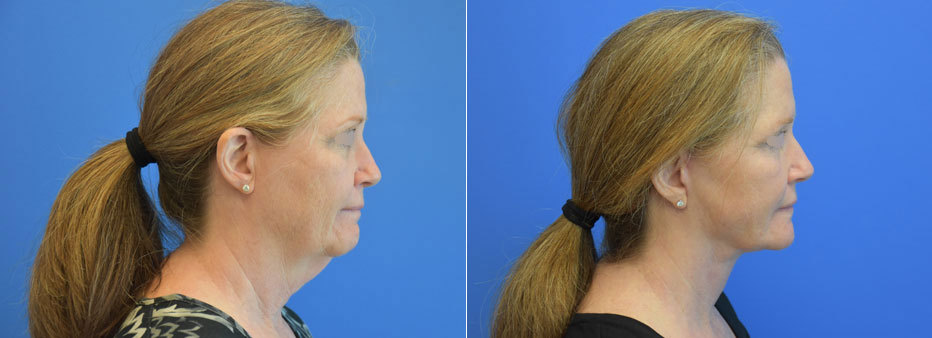
60 yo patient after full facelift including neck lift with platysma plication.
For Younger Patients: Isolated Neck Concerns
Not every neck lift patient is also a facelift patient. Some patients — often in their 30s and 40s — present with isolated neck concerns: submental fat that doesn’t respond to diet and exercise, early platysmal banding, or skin laxity that’s out of proportion to their overall facial age. These patients are often excellent candidates for an isolated neck procedure, sometimes combined with submental liposuction, that produces a targeted result without the need for more extensive facial surgery.
If the neck is your primary concern, that’s exactly where the consultation conversation should start — and Dr. Sharma will evaluate whether an isolated approach makes sense or whether addressing it in conjunction with other areas would produce a better overall result.
Next in the series, we discuss fat grafting — the volume restoration procedure that has become one of the most important tools in modern facial rejuvenation, and the one that most patients know the least about.
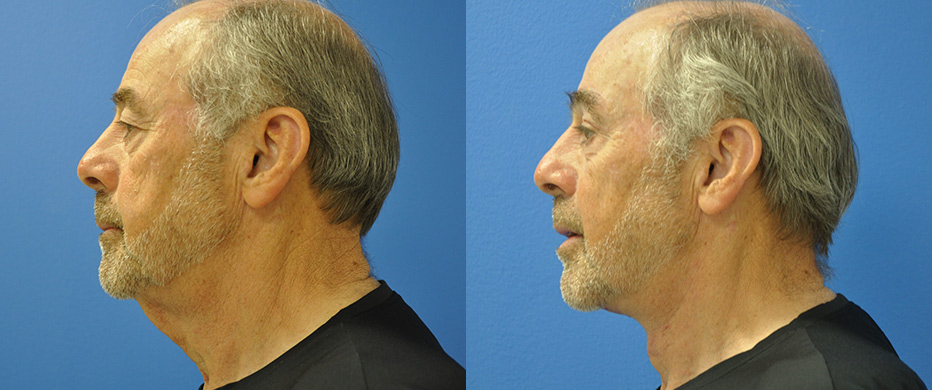
67 yo patient of Dr Sharma who desired neck contouring to improve youthful appearance
Ready to Talk Through Your Options?
If this series is raising questions about your own situation, that’s exactly what it’s meant to do. Dr. Sharma offers private consultations at his Austin practice where he’ll take the time to evaluate your concerns, explain what he sees, and help you understand what’s realistically achievable. Call (512) 324-2765 or visit the contact page to get started.