Why the Face Ages the Way It Does: A Surgeon’s Perspective
Why the Face Ages the Way It Does: A Surgeon’s Perspective
Most people first notice facial aging as a skin issue. The lines get deeper, the texture changes, and the face starts to look tired in a way that a good night’s sleep no longer fixes. It’s tempting to conclude that aging is fundamentally a surface problem — and that the solution, therefore, must live on the surface too.
But that’s not quite how it works. And understanding what’s actually happening beneath the skin is the first step toward making smart decisions about what to do about it.
As a plastic surgeon who has performed facial surgery in Austin for more than two decades, Dr. Sharma has had the opportunity to study the aging face from the inside out — literally. What he has come to understand is that facial aging is a layered, multi-structural process. It happens in the skin, yes, but also in the fat, the muscles, and even the underlying bone. Treating one layer while ignoring the others is why some surgical results look incomplete, and why some non-surgical results fade faster than expected.
The Four Layers of Facial Aging
The Skin
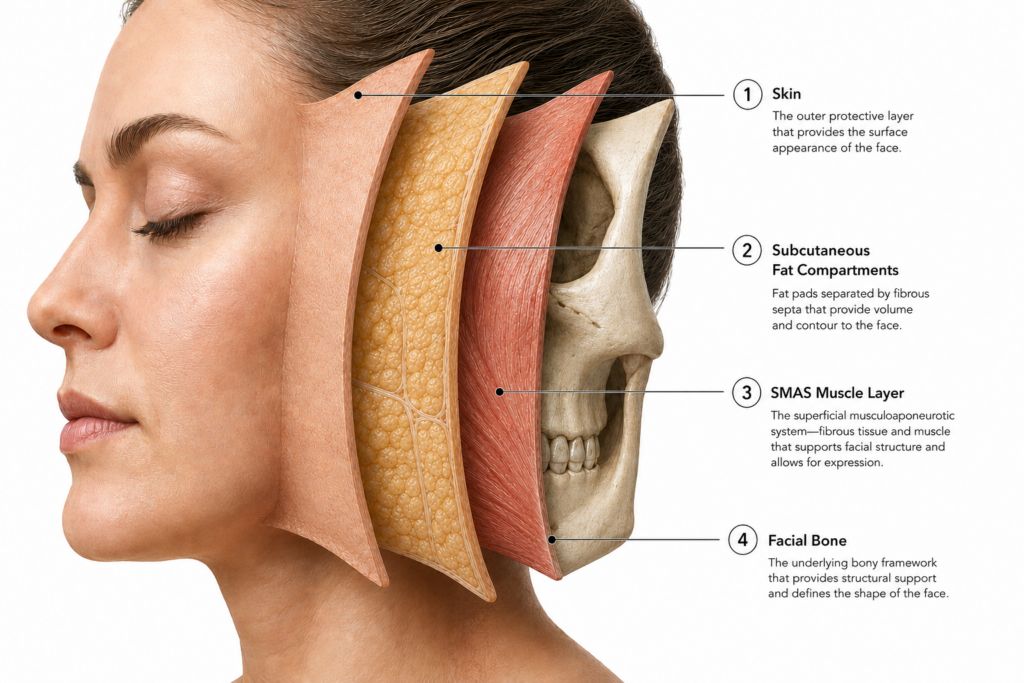
The outermost changes are the most visible. With age, the skin produces less collagen and elastin, the structural proteins that keep it firm, smooth, and resilient. Sun exposure accelerates this process significantly — something that’s worth keeping in mind in a city like Austin, where outdoor living is part of the culture year-round. The result is skin that becomes thinner, less elastic, and more prone to wrinkling. Surface treatments — chemical peels, medical-grade skincare, laser resurfacing — work primarily at this level, and they can make a meaningful difference. But they can’t address what’s happening deeper.
The Fat Compartments
This is where the picture gets more interesting. The face is not a single continuous layer of fat beneath the skin. It’s organized into distinct compartments — clusters of fat cells separated by fibrous walls — that behave somewhat independently as we age. Some of these compartments lose volume over time, causing hollowing in the temples, the under-eye area, and the cheeks. Others descend due to the loosening of the retaining ligaments that hold them in place, creating the appearance of jowling along the jaw and deepening of the nasolabial folds. This is why a face can look simultaneously deflated in some areas and heavy in others — because different compartments are doing different things.
The Muscles and SMAS
Beneath the fat lies a layer of muscle and fibrous tissue called the SMAS — the superficial musculoaponeurotic system. This is the structural scaffolding of the face, and it plays a central role in what a facelift actually accomplishes. As the SMAS loosens and descends over time, it pulls the overlying fat and skin with it. This is why simply tightening the skin — as older facelift techniques did — produces a result that looks stretched rather than naturally rejuvenated. Modern facelift surgery repositions and tightens the SMAS itself, allowing the skin to redrape naturally rather than being pulled taut.
The Bone
Perhaps the least discussed contributor to facial aging is the skeleton. Research has shown that the facial bones actually resorb and remodel with age — the orbital rim widens and drops, the midface skeleton loses projection, and the jaw loses definition. This skeletal remodeling changes the foundation that everything above it rests on. It’s one reason why volume restoration — through fat grafting or fillers — is such an important part of comprehensive facial rejuvenation. You’re not just replacing lost fat; you’re compensating for a foundation that has subtly shifted.
Why Different Zones Age Differently
One of the most useful things to understand about facial aging is that it doesn’t happen uniformly. Different regions of the face tend to show changes at different rates, and the reasons are largely anatomical.
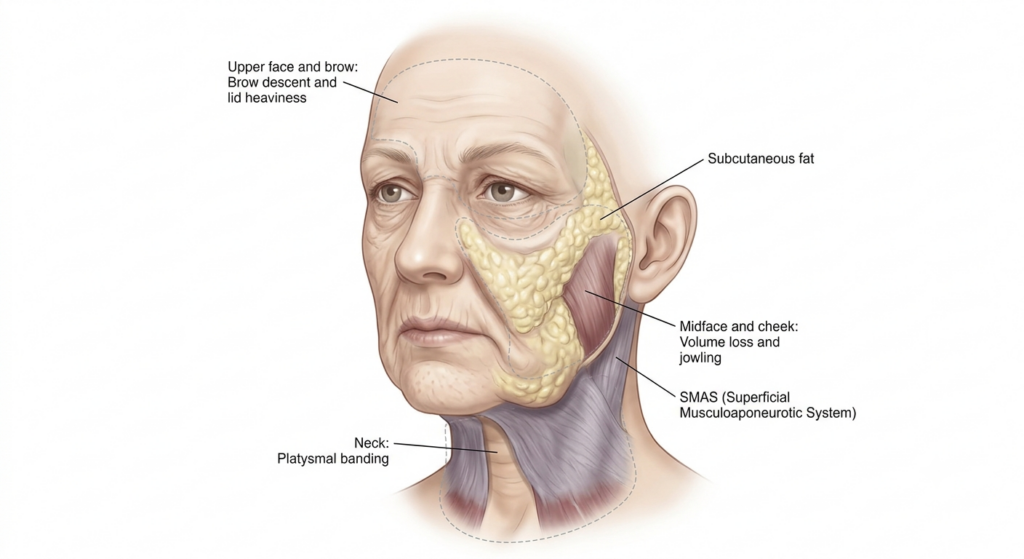
The brow and upper eyelids often show the earliest changes, because the forehead skin is thin and the brow has relatively few structural anchors to prevent it from descending. The neck tends to show significant change earlier than patients expect, because the platysma — the broad, flat muscle of the neck — begins to separate along the midline and lose tone, creating the vertical bands and loose skin that most people find particularly frustrating. The midface tends to show more significant changes in the 50s and 60s, when volume loss and SMAS descent combine to produce the jowling and deepened folds that are the primary driver of facelift consultations.
Understanding this zone-by-zone picture is important because it shapes the conversation in the consultation room. The area that bothers you most may or may not be the area that would benefit most from intervention — and sometimes addressing a different zone first produces a more meaningful overall result.
What Facial Aging Means for Treatment Planning
The takeaway from all of this is that the most effective facial rejuvenation isn’t about a single procedure. It’s about understanding which layers and which zones have changed in your particular face — and building a plan that addresses them in a coordinated way.
For some patients, that plan is surgical and comprehensive. For others, it involves a targeted combination of a surgical procedure in one area and non-surgical maintenance in others. And for patients earlier in the aging process, it might mean strategic non-surgical intervention now with the understanding that surgery may make sense down the road.
There’s no universal answer. But there is a logical framework — and it starts with understanding what’s actually happening beneath the surface.
In the posts that follow, we’ll go zone by zone through the face — starting with the brow and upper face and working our way down through the eyes, midface, neck, and beyond — and discuss what each area involves, what changes it best, and what realistic results look like.
Ready to Talk Through Your Options?
If this series is raising questions about your own situation, that’s exactly what it’s meant to do. Dr. Sharma offers private consultations at his Austin practice where he’ll take the time to evaluate your concerns, explain what he sees, and help you understand what’s realistically achievable. Call (512) 324-2765 or visit the contact page to get started.