
The Upper Face: What a Brow Lift Actually Does and Who Really Needs One
The Upper Face: What a Brow Lift Actually Does and Who Really Needs One
Of all the procedures involved in facial rejuvenation, the brow lift is probably the most misunderstood — and the most underestimated. Many patients come in focused on their eyes, convinced that eyelid surgery is what they need, when in fact the heaviness they’re seeing in the mirror has much more to do with a descended brow than with the eyelids themselves.
Getting this distinction right matters enormously. Removing upper eyelid skin when the real problem is brow descent can produce an odd result — and sometimes makes the brow look even heavier by comparison. A thorough evaluation of the upper face as a whole is what leads to the right recommendation. As we discussed in the first post in this series, the brow and upper eyelids are often where facial aging shows up earliest, because the forehead skin is thin and the brow has relatively few structural anchors to prevent it from descending.
What the Brow Lift Actually Does
The term “brow lift” is straightforward enough, but the procedure is more nuanced than simply pulling the forehead up. The goal is to restore the brow to a position that looks youthful and natural for that patient’s anatomy — not to create an artificially elevated or surprised appearance, which is the result most people are trying to avoid.
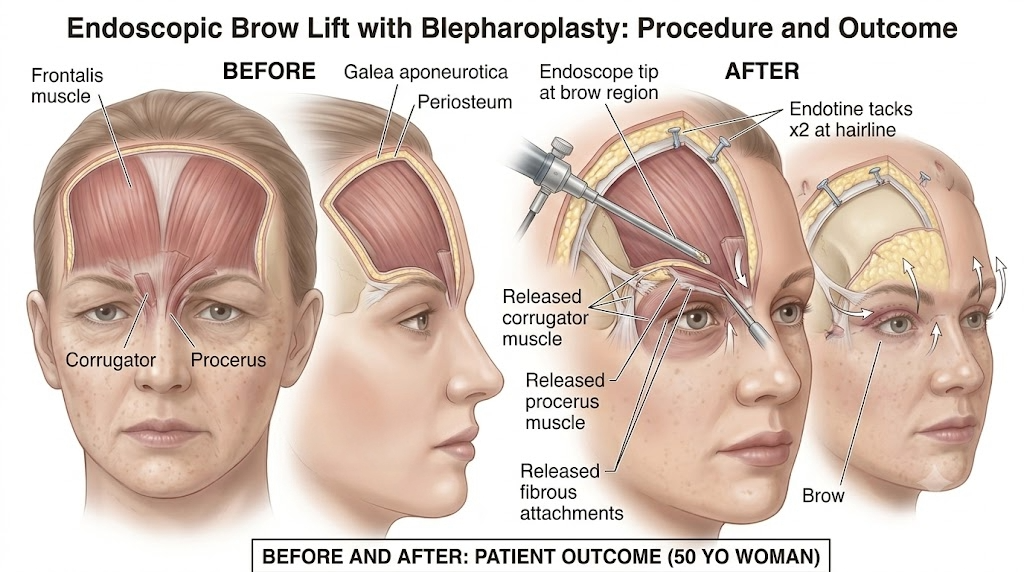
There are several techniques Dr. Sharma may use depending on your anatomy and goals. The endoscopic brow lift, performed through several small incisions hidden within the hairline, uses a small camera to visualize and reposition the brow and forehead tissues from within. It produces minimal visible scarring and works well for patients whose primary concern is brow descent rather than significant excess forehead skin. For patients who need more correction or who have a longer forehead, a coronal or hairline approach may be more appropriate, allowing for greater tissue removal and repositioning.
In all cases, the procedure addresses not just the position of the brow but also the muscles responsible for the horizontal lines across the forehead and the vertical frown lines between the brows — the corrugators. Releasing or weakening these muscles produces a smoother forehead and reduces the perpetually tense or stern expression that many patients find so aging.
The Brow-Eye Relationship
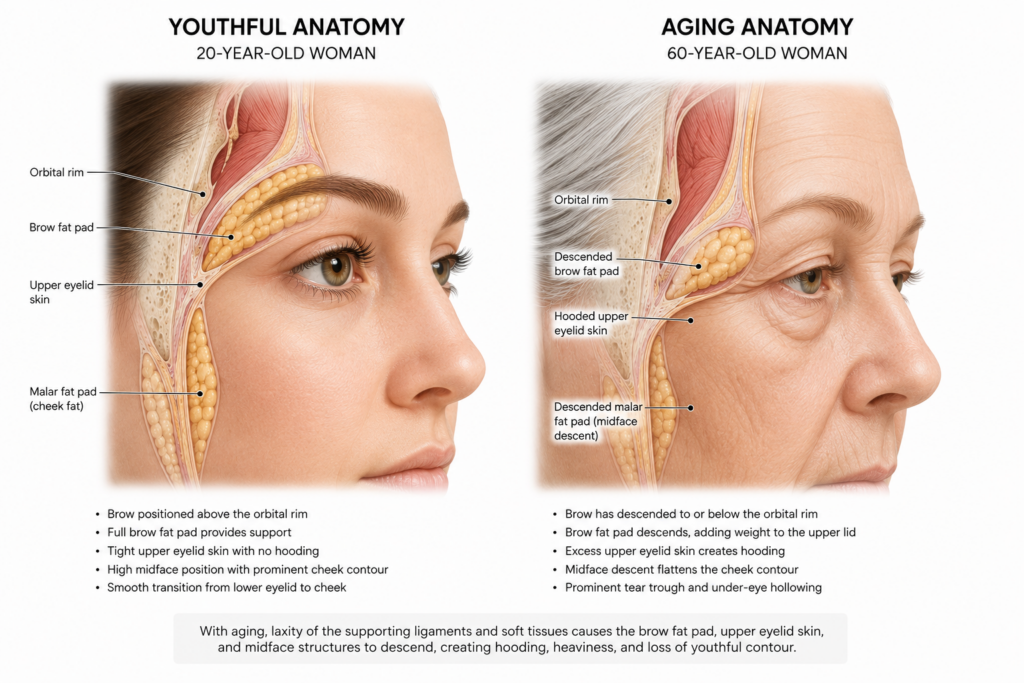
One of the most useful concepts in upper face analysis is the idea that the brow and the eyelid can’t really be evaluated independently. The position of the brow directly determines how much upper eyelid skin is visible — and how heavy the entire upper face looks. When the brow has descended significantly, it pushes skin downward onto the upper eyelid, which compounds any existing eyelid laxity and creates that characteristic heavy, hooded appearance.
This is why many patients who come in requesting upper blepharoplasty actually benefit more from a brow lift, or from a combination of both. During your consultation, Dr. Sharma will evaluate the brow position carefully — physically lifting the brow to simulate where it would sit after surgery — to help you understand which area is contributing most to the appearance you want to change.
Who Is a Candidate?
The ideal brow lift candidate is someone who notices that their brow sits at or below the orbital rim — the bony upper edge of the eye socket — creating a heavy or hooded upper face. This is usually more pronounced on one side than the other, which is worth noting during your own self-evaluation. Asymmetry is the norm in facial aging, not the exception.
Patients who look chronically tired or irritable — and who hear comments from others that don’t match how they actually feel — are often the patients for whom a brow lift produces the most dramatic transformation. The change isn’t just cosmetic; it’s the elimination of a visual signal that was consistently misrepresenting them.
Good candidates are generally in good overall health, non-smokers, and have realistic expectations about what the procedure can accomplish. A brow lift rejuvenates the upper face — it doesn’t change the fundamental structure of your face or make you look like a different person.
Recovery and Results
Recovery from a brow lift is typically less involved than recovery from a facelift. Most patients experience some swelling and temporary numbness across the forehead in the first week, which resolves gradually over the following two to three weeks. Sutures or staples are removed within the first week, and most patients feel comfortable returning to work and social activities within two weeks.
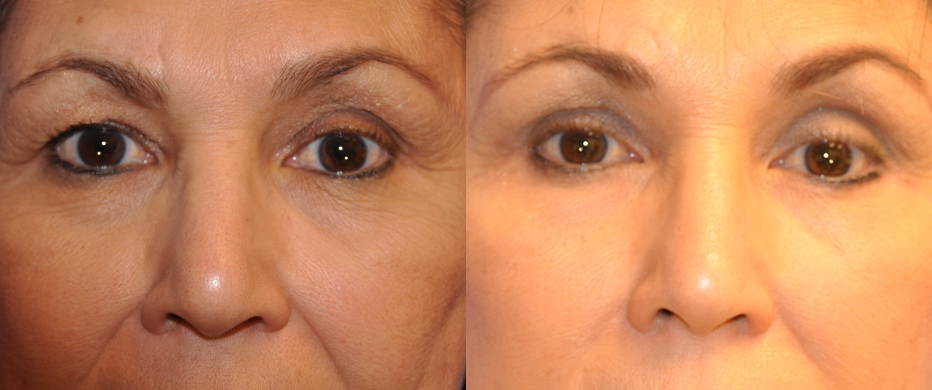
Results are long-lasting. While a brow lift doesn’t stop the aging process, most patients find that their results remain noticeably refreshed for seven to ten years or more. The procedure is also frequently combined with upper eyelid surgery or a facelift, allowing patients to address multiple zones in a single recovery — something that makes both practical and aesthetic sense.
In the next post in this series, we’ll go deeper into the eyes themselves — both upper and lower lids — and discuss why blepharoplasty is consistently one of the most satisfying procedures in facial surgery.
Ready to Talk Through Your Options?
If this series is raising questions about your own situation, that’s exactly what it’s meant to do. Dr. Sharma offers private consultations at his Austin practice where he’ll take the time to evaluate your concerns, explain what he sees, and help you understand what’s realistically achievable. Call (512) 324-2765 or visit the contact page to get started.